
Antique Indian Navaratna Ring
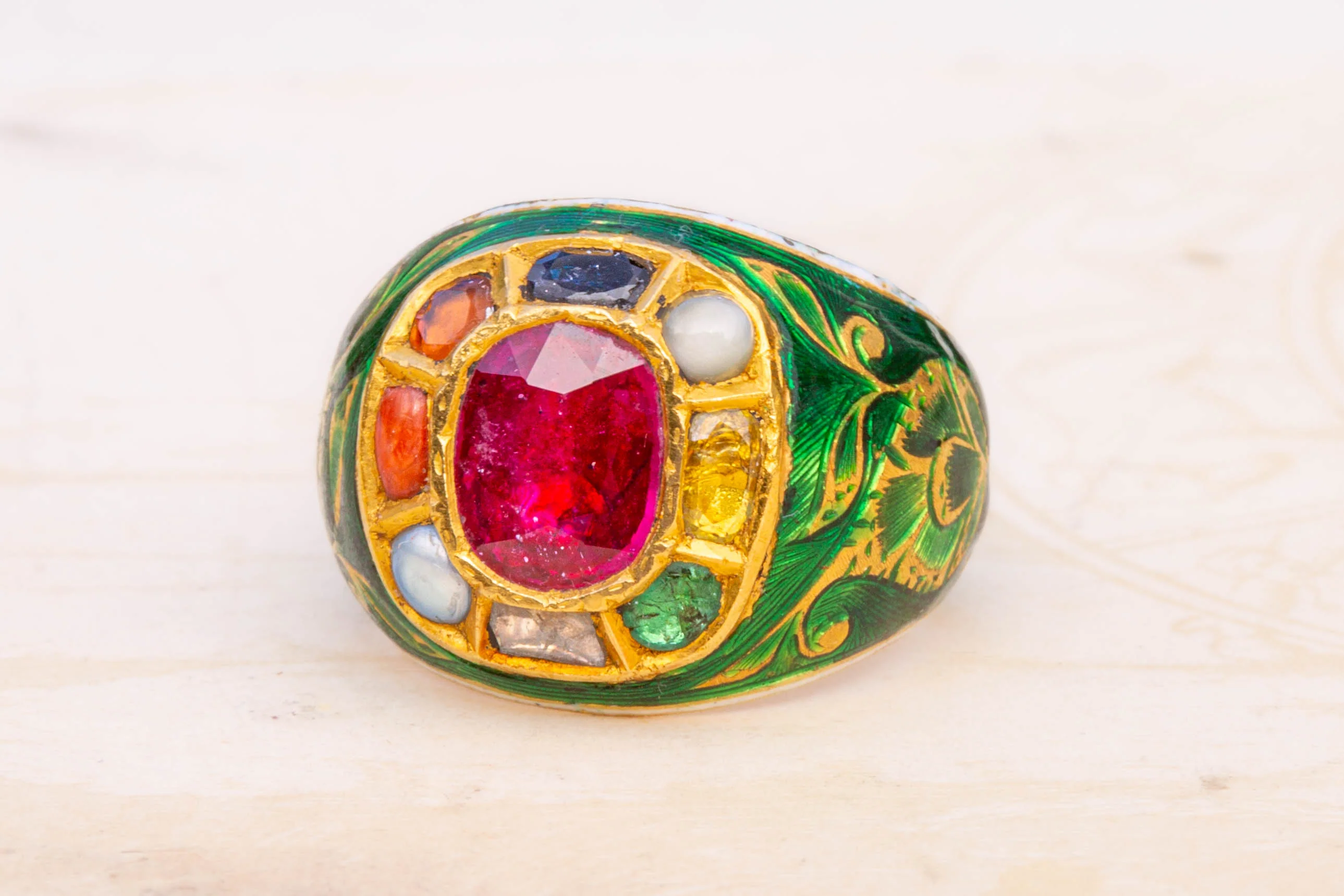
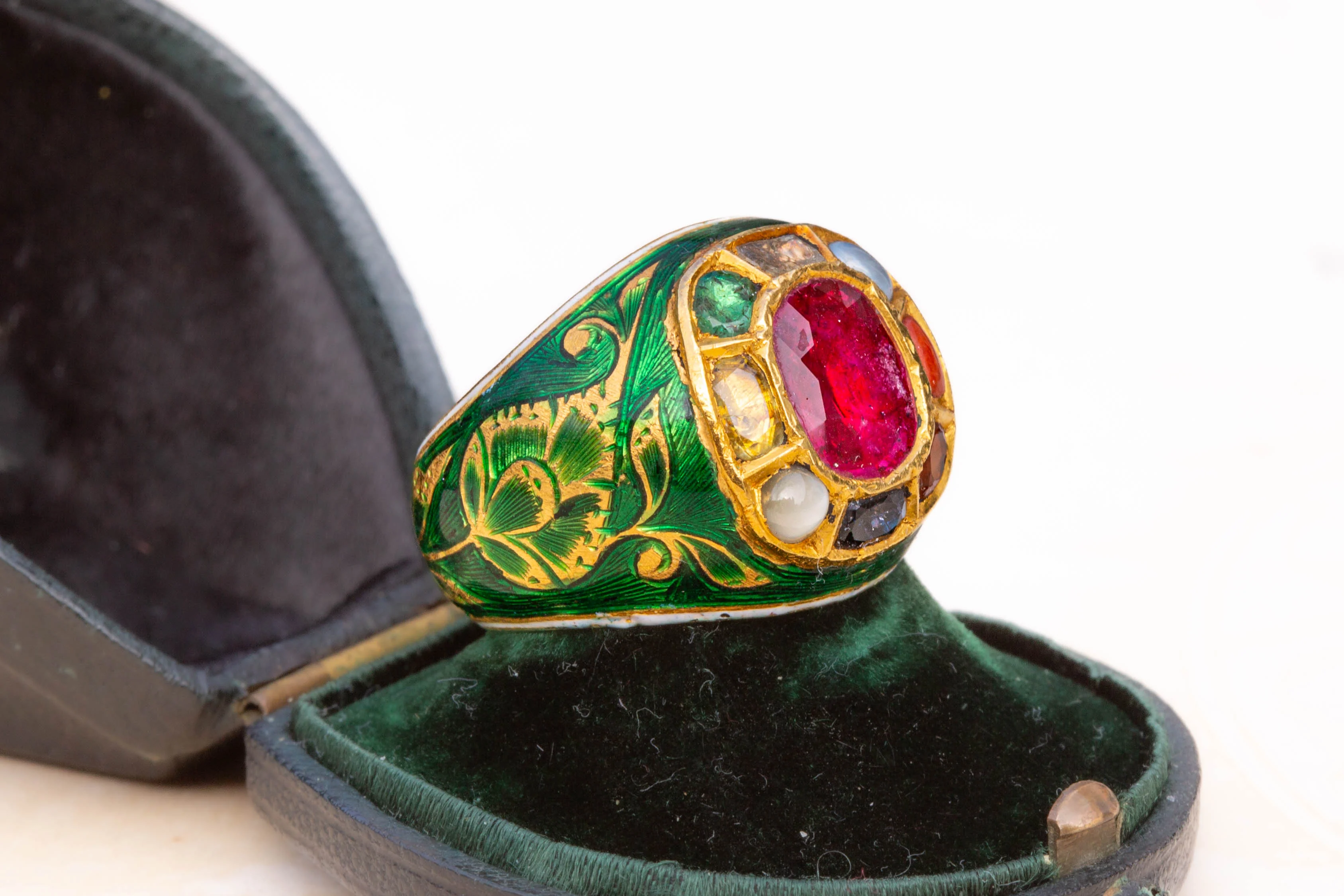
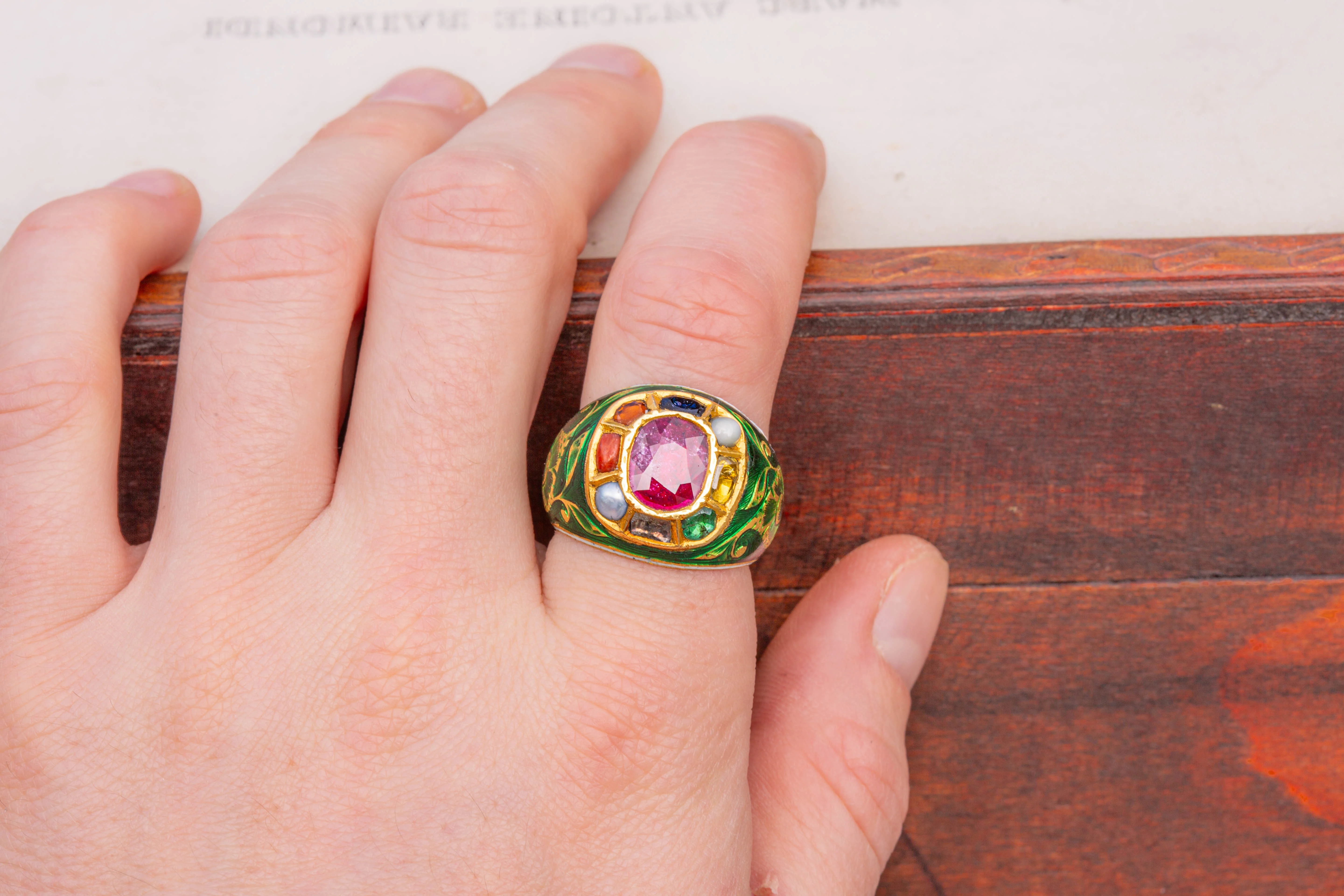
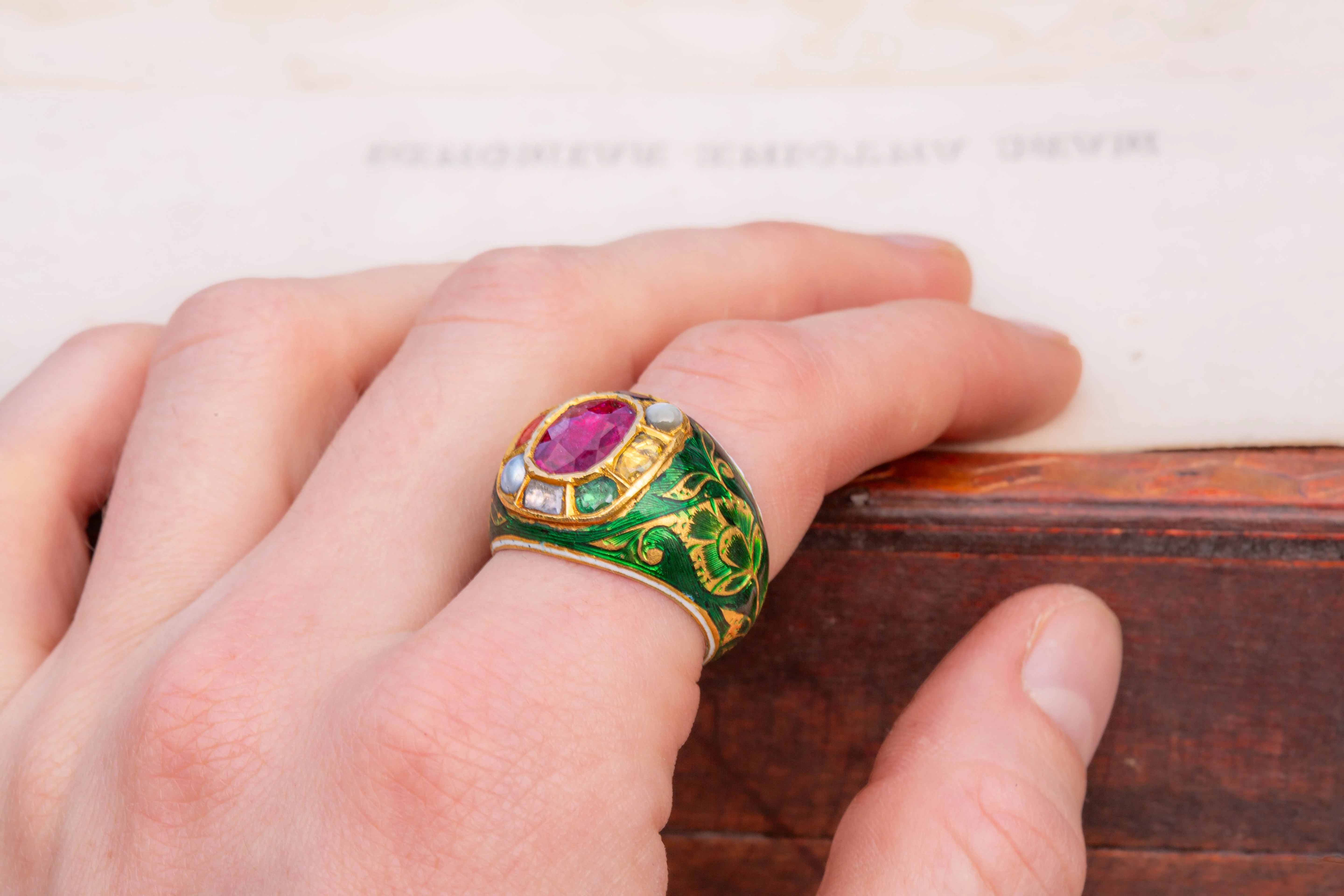
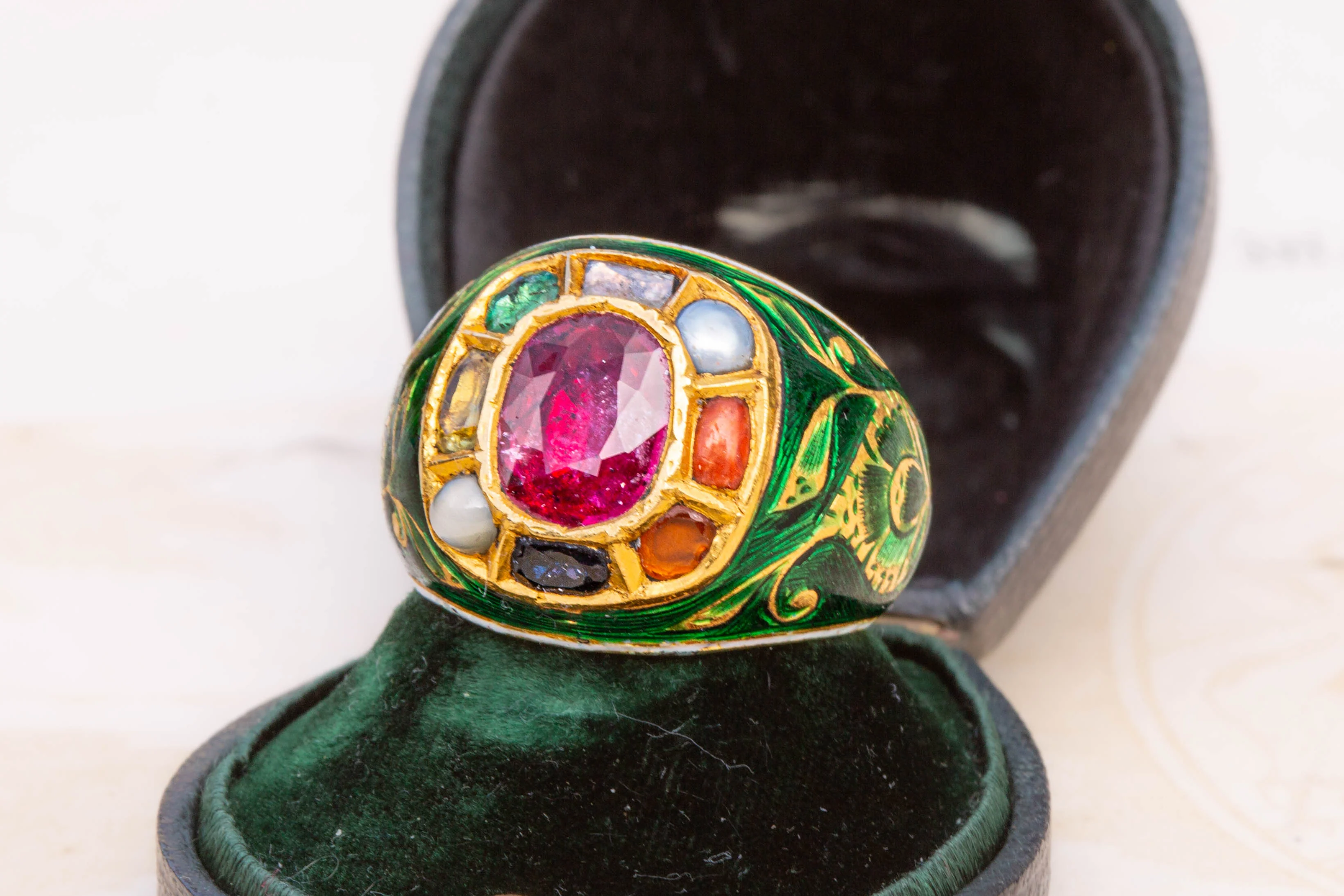
A fantastic Indian talismanic enamelled gold Navaratna ring dating from the early 20th century.
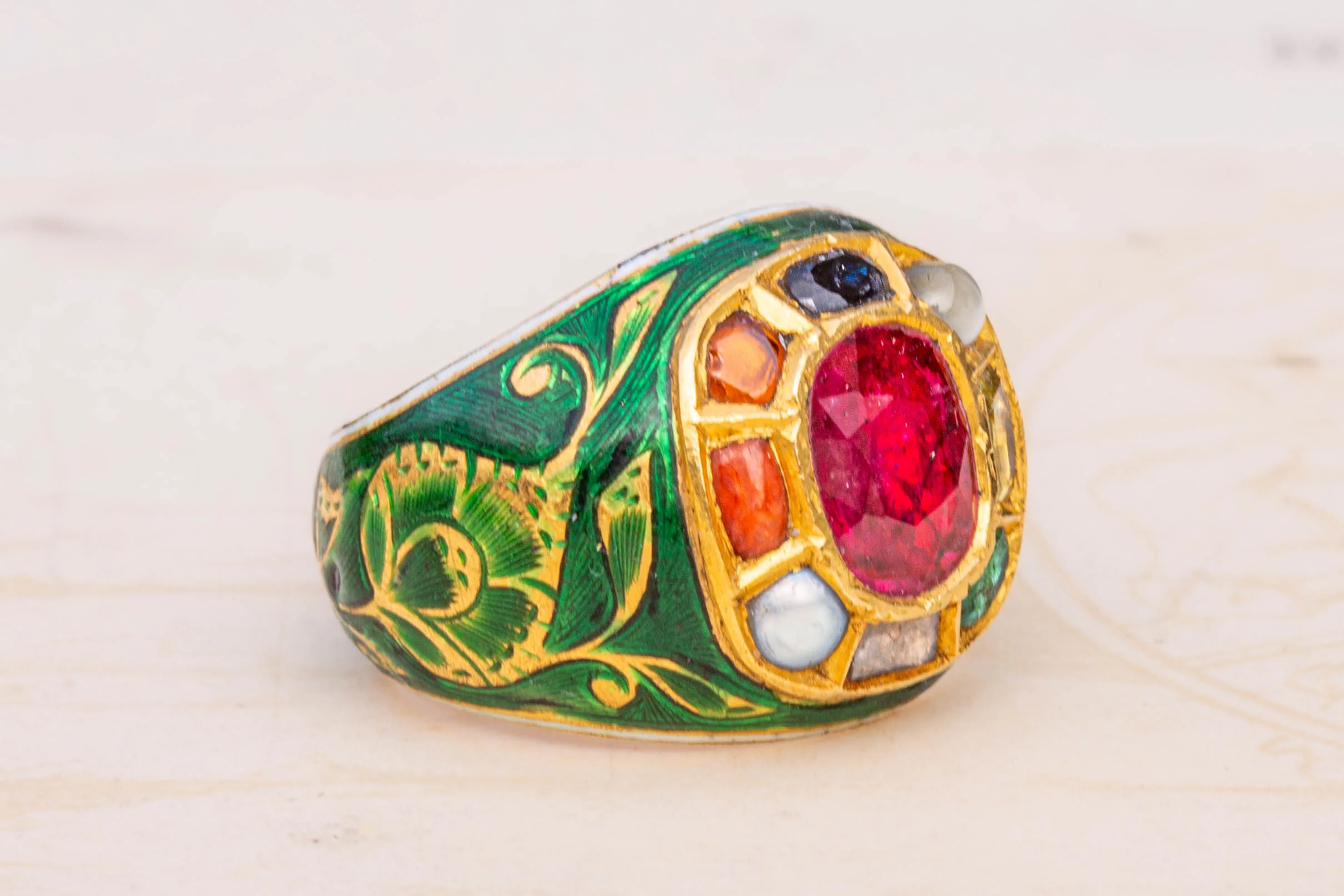
A navratna is composed of nine gems that represent the nine cosmic influences from the Hindu system of astrology. This combination of nine gems has been regarded as sacred and royal in many Asian countries since ancient times. The ruby at the centre represents the sun, surrounded by diamond as Venus, pearl as the moon, red coral as Mars, hessonite as Ragu (the ascending lunar node), sapphire as Saturn, cat's eye chrysoberyl as Ketu (the descending lunar node), yellow sapphire as Jupiter and emerald as Mercury.
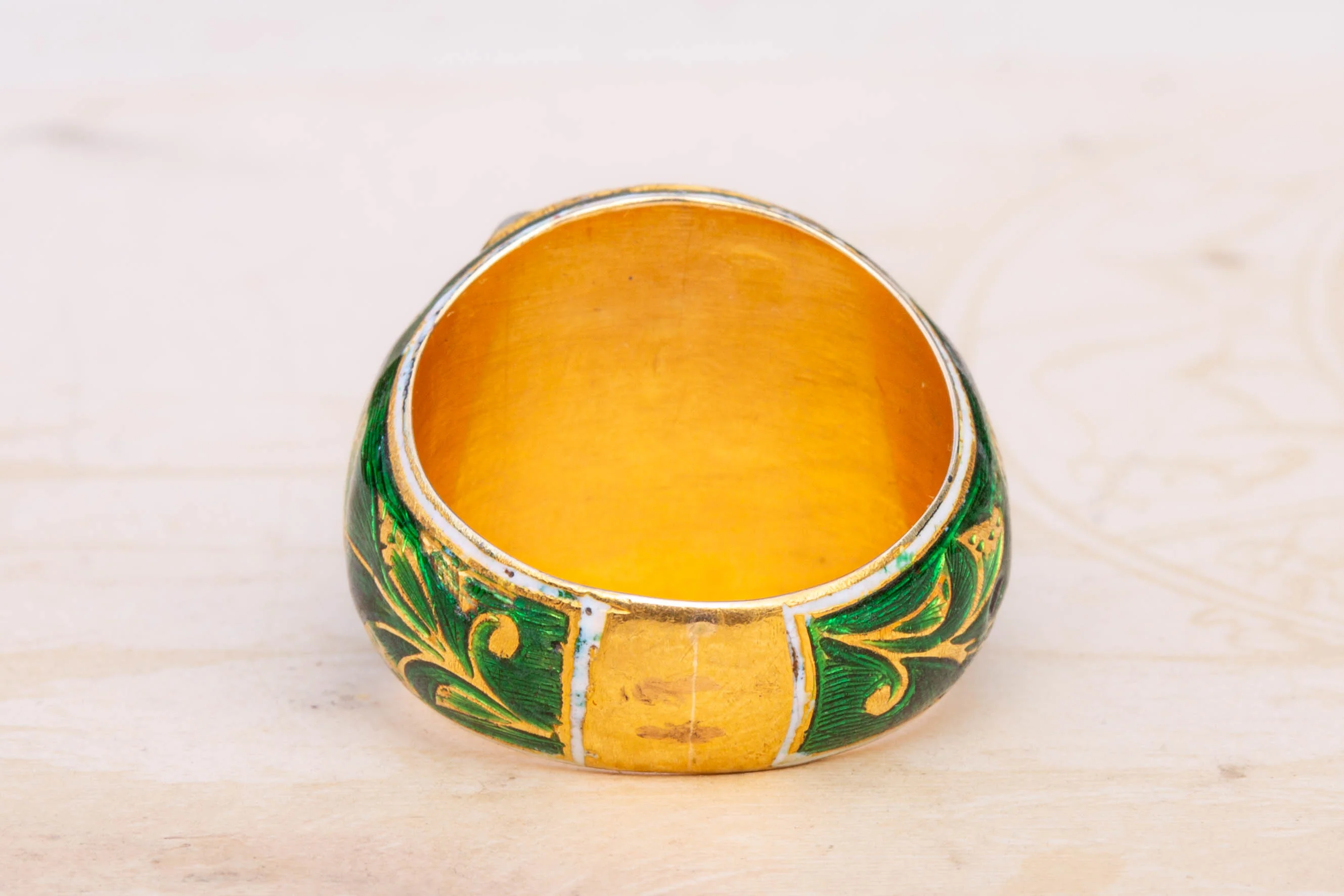
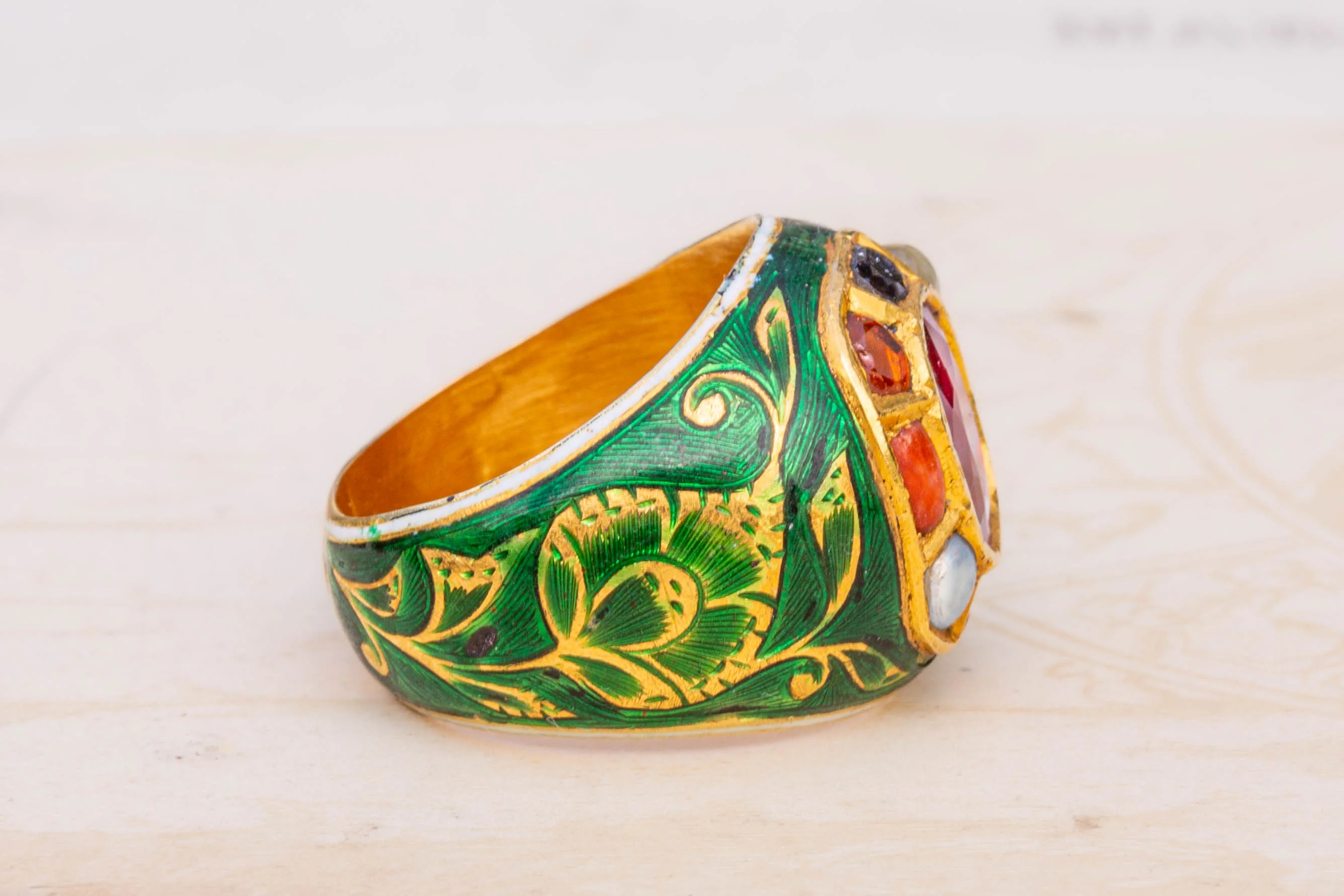
The gem-set cluster takes a domed bombe-ring form, the exterior decorated with green guilloché enamel in traditional minakari style contrasting with intricate floral engravings. The ring is crafted in high-karat gold and all of the gemstones are set in closed-back kundan settings.
UK size Q 1/2, US size 8.25
The ring weighs 9.8 grams, and tests as 22K gold. It remains in great overall condition, there is minimal wear to the enamel, all the stones are securely set, and there is evidence of a historic resizing at the back of the band. The face measures 18mm north to south, whilst the back of the ring measures 7mm across. The largest stone, the ruby cabochon weighs approximately 0.85ct - 1ct, whilst the smaller stones have a diameter of 4mm. The yellow gold has a warm patina.
According to Oppi Untracht in his book ‘Traditional Jewelry of India’ (1997), the proper construction of a navaratna ring can take a very long time, ‘before commissioning such a ring from a goldsmith, one first brings the selected stones to a priest, who blesses them. At an auspicious time, they are then given to a goldsmith who will set thing in high-quality gold (22 karat). According to orthodox practice, when the gold setting is ready, each of the stones corresponding to a planet is set in the correct order of priority and position, at a time auspicious for the planet. If this procedure is followed, the process might take more than a year to complete.
Product Information
Product Information
Shipping & Returns
Shipping & Returns
Description
A fantastic Indian talismanic enamelled gold Navaratna ring dating from the early 20th century.
A navratna is composed of nine gems that represent the nine cosmic influences from the Hindu system of astrology. This combination of nine gems has been regarded as sacred and royal in many Asian countries since ancient times. The ruby at the centre represents the sun, surrounded by diamond as Venus, pearl as the moon, red coral as Mars, hessonite as Ragu (the ascending lunar node), sapphire as Saturn, cat's eye chrysoberyl as Ketu (the descending lunar node), yellow sapphire as Jupiter and emerald as Mercury.
The gem-set cluster takes a domed bombe-ring form, the exterior decorated with green guilloché enamel in traditional minakari style contrasting with intricate floral engravings. The ring is crafted in high-karat gold and all of the gemstones are set in closed-back kundan settings.
UK size Q 1/2, US size 8.25
The ring weighs 9.8 grams, and tests as 22K gold. It remains in great overall condition, there is minimal wear to the enamel, all the stones are securely set, and there is evidence of a historic resizing at the back of the band. The face measures 18mm north to south, whilst the back of the ring measures 7mm across. The largest stone, the ruby cabochon weighs approximately 0.85ct - 1ct, whilst the smaller stones have a diameter of 4mm. The yellow gold has a warm patina.
According to Oppi Untracht in his book ‘Traditional Jewelry of India’ (1997), the proper construction of a navaratna ring can take a very long time, ‘before commissioning such a ring from a goldsmith, one first brings the selected stones to a priest, who blesses them. At an auspicious time, they are then given to a goldsmith who will set thing in high-quality gold (22 karat). According to orthodox practice, when the gold setting is ready, each of the stones corresponding to a planet is set in the correct order of priority and position, at a time auspicious for the planet. If this procedure is followed, the process might take more than a year to complete.