🎉 Up to 70% Off Selected ItemsShop Sale


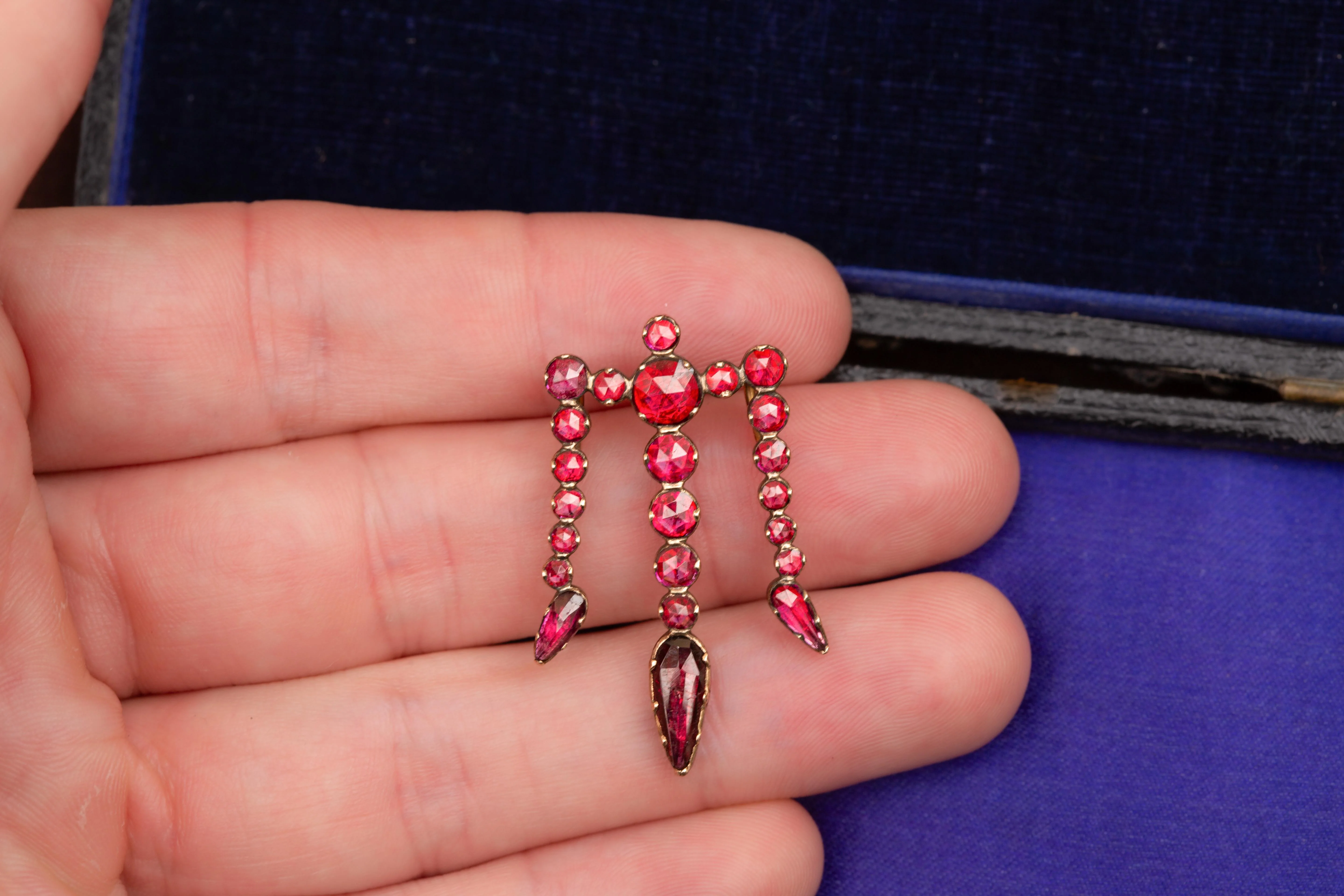

Antique Garnet Trident Pendant
An unusual and highly symbolic jewel of the French early-to-mid 19th century, crafted in 18K gold and set with foiled rose-cut garnets, most likely the celebrated “Perpignan” garnets of southern France.
The jewel is modelled as a trident, its three points terminating in pear-shaped garnet drops, with a larger central rose-cut garnet anchoring the design.
The back shows evidence of later conversion, with two suspension hoops added to convert what was likely part of a brooch jewel - into a wearable pendant.
Symbolism of the Trident
The trident is an ancient emblem, most famously associated with Neptune (Poseidon), god of the sea, where it symbolised dominion over the waters and maritime power. Its use in French jewels of the early 19th century reflects the neoclassical revival of mythological imagery, often reinterpreted in bold, geometric compositions such as this.
Details
- Origin: French, c.1820–1840
- Material: Tests as 18K gold (unmarked)
- Stones: Foiled rose-cut garnets, including a central garnet of approx. 5 mm diameter
- Dimensions: 3.5 × 2.2 cm
- Weight: 3 g
Condition
Good antique condition. Some dents to the hollow reverse of the gold backing, not visible when worn. Later conversion to pendant, but well executed and stable. Garnets remain lively with the distinctive deep raspberry-red tone associated with Perpignan foiled garnets.
Context and Comparisons
Perpignan garnet jewels were especially prized in the Roussillon region of France during the 18th and 19th centuries, where foiling techniques created a vivid, almost glowing effect. While most surviving examples are floral or geometric in form, a trident motif is rare and appears to reflect neoclassical taste for mythological symbolism.
$1,206.06
Antique Garnet Trident Pendant—
$1,206.06
Product Information
Product Information
Shipping & Returns
Shipping & Returns
Description
An unusual and highly symbolic jewel of the French early-to-mid 19th century, crafted in 18K gold and set with foiled rose-cut garnets, most likely the celebrated “Perpignan” garnets of southern France.
The jewel is modelled as a trident, its three points terminating in pear-shaped garnet drops, with a larger central rose-cut garnet anchoring the design.
The back shows evidence of later conversion, with two suspension hoops added to convert what was likely part of a brooch jewel - into a wearable pendant.
Symbolism of the Trident
The trident is an ancient emblem, most famously associated with Neptune (Poseidon), god of the sea, where it symbolised dominion over the waters and maritime power. Its use in French jewels of the early 19th century reflects the neoclassical revival of mythological imagery, often reinterpreted in bold, geometric compositions such as this.
Details
- Origin: French, c.1820–1840
- Material: Tests as 18K gold (unmarked)
- Stones: Foiled rose-cut garnets, including a central garnet of approx. 5 mm diameter
- Dimensions: 3.5 × 2.2 cm
- Weight: 3 g
Condition
Good antique condition. Some dents to the hollow reverse of the gold backing, not visible when worn. Later conversion to pendant, but well executed and stable. Garnets remain lively with the distinctive deep raspberry-red tone associated with Perpignan foiled garnets.
Context and Comparisons
Perpignan garnet jewels were especially prized in the Roussillon region of France during the 18th and 19th centuries, where foiling techniques created a vivid, almost glowing effect. While most surviving examples are floral or geometric in form, a trident motif is rare and appears to reflect neoclassical taste for mythological symbolism.