🎉 Up to 70% Off Selected ItemsShop Sale

Indo-Persian Gilded Amulet Pendant
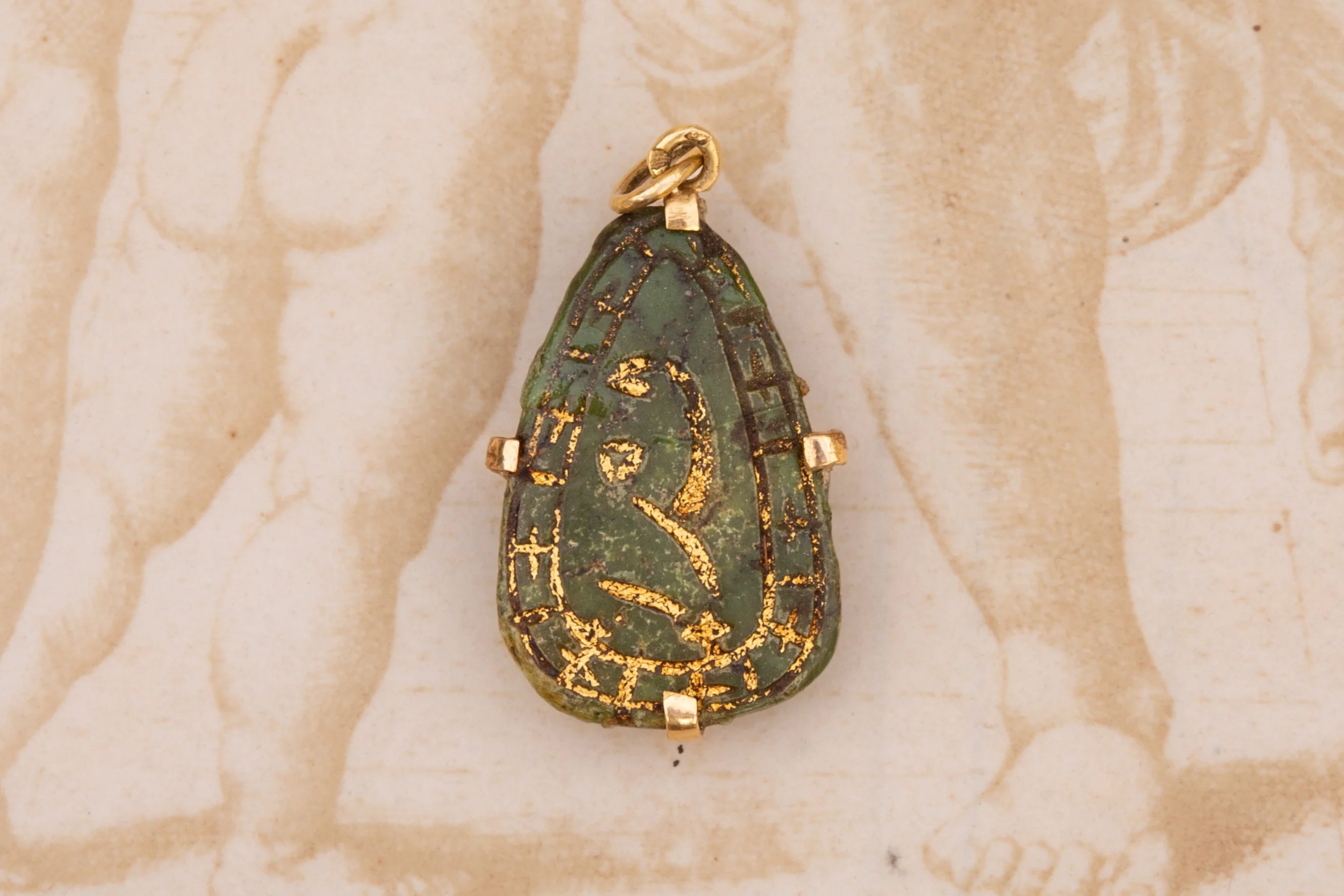
A finely preserved Indo-Persian amulet pendant dating to around 1890, carved from deep green gemstone, possibly agate or serpentine. The surface is intricately engraved with nastaliq calligraphy, which was then delicately gilded in gold and sealed under a protective resin or shellac, giving it a distinctive glossy depth.
The amulet has been later mounted in France in an 18ct gold setting, with French eagle head hallmark and maker’s lozenge struck to the bail. This restrained mount ensures that the engraved gem remains the focal point. The reverse is simply cross-banded in gold, with some shellac still visible over the setting.
Such amulets were valued across the Islamic world for both their spiritual and protective properties, the engraved Qur’anic inscriptions intended to act as talismans for the wearer. This example has survived in good condition, with some wear to the gilding but an appealing patina to the surface, showing its age and long devotional use.
A rare and evocative object of Indo-Persian craftsmanship.
$194.98
Original: $649.93
-70%Indo-Persian Gilded Amulet Pendant—
$649.93
$194.98Product Information
Product Information
Shipping & Returns
Shipping & Returns
Description
A finely preserved Indo-Persian amulet pendant dating to around 1890, carved from deep green gemstone, possibly agate or serpentine. The surface is intricately engraved with nastaliq calligraphy, which was then delicately gilded in gold and sealed under a protective resin or shellac, giving it a distinctive glossy depth.
The amulet has been later mounted in France in an 18ct gold setting, with French eagle head hallmark and maker’s lozenge struck to the bail. This restrained mount ensures that the engraved gem remains the focal point. The reverse is simply cross-banded in gold, with some shellac still visible over the setting.
Such amulets were valued across the Islamic world for both their spiritual and protective properties, the engraved Qur’anic inscriptions intended to act as talismans for the wearer. This example has survived in good condition, with some wear to the gilding but an appealing patina to the surface, showing its age and long devotional use.
A rare and evocative object of Indo-Persian craftsmanship.